
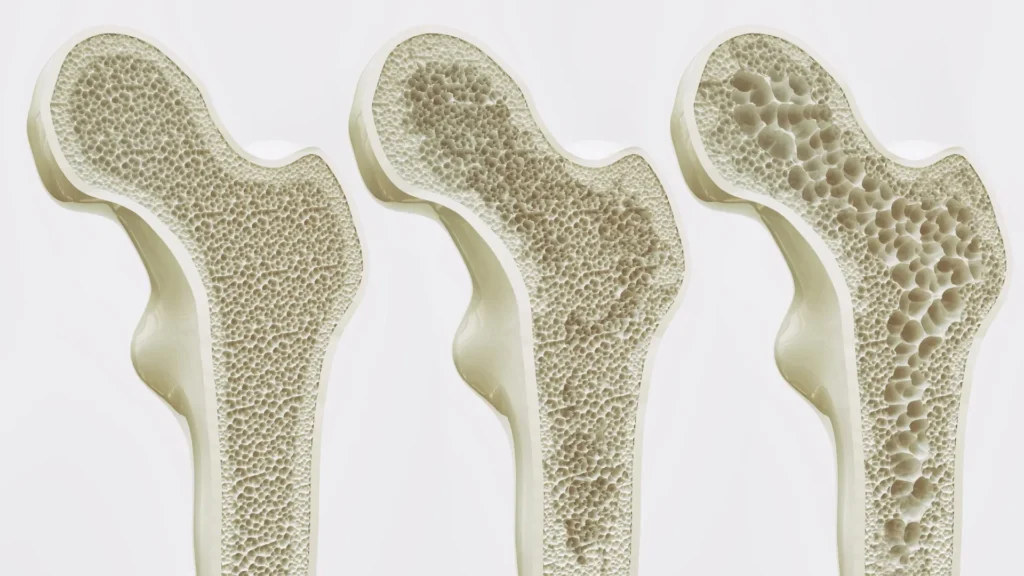
If you want to strengthen bones after 50, here’s the encouraging truth: your skeleton is living tissue that responds to how you load it, at any age. Scientists are even racing to bottle that effect. Recent research out of Leipzig University found a compound that reversed bone loss in mice by switching on the body’s natural bone-building machinery, essentially mimicking what exercise already does. That’s promising for the future. But you don’t have to wait for a lab breakthrough to strengthen bones after 50—the tools that work are available to you right now.
Why Bone Loss Speeds Up After 50
Bone is constantly being broken down and rebuilt. Earlier in life, building keeps pace with breakdown. After about age 50, and especially in the years around menopause, when estrogen drops, the balance tips toward loss. According to the National Institute of Arthritis and Musculoskeletal and Skin Diseases, that shift is what raises the risk of osteopenia, osteoporosis, and fractures. Men lose bone too, just typically later and more slowly.
The good news is that the same signal that builds bone—mechanical load—still works after 50. That’s why the effort to strengthen bones after 50 comes down to loading your skeleton on purpose and giving it the nutrients to rebuild.
6 Ways to Strengthen Bones After 50
1. Lift Heavy Enough to Matter
Resistance training is the cornerstone. Bones adapt to force, so lifting challenging weights signals them to hold onto and add mineral density. Reviews of exercise in postmenopausal women point to higher-intensity resistance training (working in the range of roughly 70–80% of your one-rep max, two to three times a week) as one of the most effective ways to improve bone health. Light stretchy-band circuits won’t get you there; to strengthen bones after 50, you need to progress to loads that genuinely challenge you.
2. Add a Little Impact
Weight-bearing, higher-impact movement—things like hopping, skipping, step-ups, or brisk stair climbing—creates the kind of ground-reaction force that stimulates bone formation at the hip and spine. You don’t need to become a plyometrics athlete; a few controlled impacts sprinkled through the week add a potent bone signal that steady walking alone doesn’t. It’s one of the most underused ways to strengthen bones after 50.
3. Train Your Balance
Strengthening bone is only half the equation. The other half is not falling on it. Balance and stability work (single-leg stands, controlled step-downs, tai-chi-style drills) reduces fall risk, which is what actually turns a fragile bone into a fractured one. For anyone working to strengthen bones after 50, balance training is non-negotiable insurance.
4. Get Enough Calcium and Vitamin D
Exercise gives bone the signal to build; nutrition gives it the raw material. Calcium is the mineral your bones are built from, and vitamin D helps you absorb it. NIAMS notes that if you don’t get enough calcium, your body pulls it from your bones, weakening them over time. Aim to meet your daily targets through food first (dairy, leafy greens, fortified foods) and talk to your provider about whether a supplement makes sense for you.
5. Eat Enough Protein
Bone isn’t just minerals; its underlying framework is protein (collagen). Under-eating protein, common as appetite changes with age, undercuts both bone and the muscle that protects it. Spreading adequate protein across your meals supports the muscle-and-bone system you’re working to strengthen after 50.
6. Stay Consistent and Keep Progressing
Bone remodels slowly, so results come from months of steady loading, not a two-week push. The key is progressive overload: gradually adding weight, reps, or impact as you get stronger, so the stimulus keeps pace with your improving body. When you’re trying to strengthen bones after 50, consistency is genuinely the difference-maker.
A Quick Word on That New Bone-Strength Research
It’s easy to get excited about a molecule that “reverses” bone loss. The Leipzig finding is real and hopeful, but it was tested in mice, and any human treatment is years of trials away. Notably, what the compound did was imitate exercise. The most reliable, available, side-effect-free way to strengthen bones after 50 today is still to load them and feed them well.
A Safety Note Before You Start
Heavy lifting and impact are powerful bone stimuli, but they should be matched to your body. If you’ve already been diagnosed with osteoporosis, have had a fragility fracture, or aren’t sure where you stand, get assessed before diving into high-impact or maximal lifting—NIH guidance emphasizes that these programs are safe and effective when appropriately supervised. A professional can build the load up safely instead of guessing.
Frequently Asked Questions
Can you actually rebuild bone density after 50?
You can meaningfully improve it. While dramatic reversals are uncommon, resistance and impact training can preserve density and, in many people, produce modest gains, along with stronger muscles and better balance that lower fracture risk.
Is it ever too late to strengthen your bones?
No. Bone responds to load throughout life. Even in your 60s, 70s, and beyond, appropriately progressed strength and balance training improves bone health and reduces the chance of a fall-related fracture. It’s never too late to start working to strengthen bones after 50 and well past it.
What exercises are safest if I already have osteoporosis?
Generally, controlled resistance training and balance work, with impact and spinal-flexion movements modified to your risk level. Because the right plan depends on your bone density and history, this is exactly where a guided assessment pays off.
Build Stronger Bones in Greenville, SC
Knowing you should lift is one thing; knowing how to load safely and progressively after 50 is another. At Movement Solutions in Greenville, SC, we help active adults build the strength that protects their bones for life—the same strength-training-as-you-age approach we use with every client. Reach out today to ask about cost and availability, or call (864) 558-7346.
Medically reviewed by Dr. Tim Varghese, PT, DPT · Last updated August 12, 2026

Dr. Tim Varghese, PT, DPT
Dr. Tim Varghese, PT, DPT, is the founder of Movement Solutions Physical Therapy in Greenville, SC. He earned his Doctor of Physical Therapy from the Medical College of Georgia and is a Board-Certified Orthopedic Clinical…
More about Dr. Tim →