
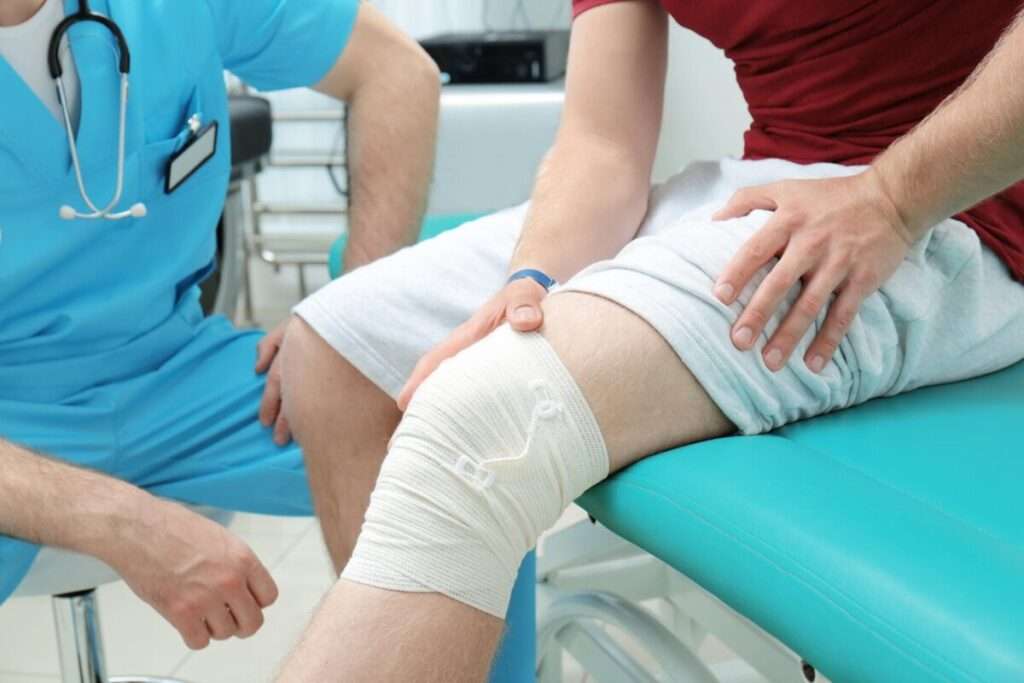
Knee replacement recovery is a months-long journey, and the people who do best treat it that way: steady, guided, and patient. The knee is the most commonly replaced joint in the body, and a total knee replacement can dramatically reduce pain and restore function, but the surgery is only half the story. What you do afterward, especially the rehab, is what determines how strong and mobile your new knee becomes. Below are five powerful steps to knee replacement recovery so you know what to expect and how to get the most from your result.
Knee replacement recovery progresses through five steps, usually starting with walking (with a walker or cane) within a day or two:
| Step | Focus |
|---|---|
| 1. Calm pain & swelling | Ease pain and swelling; begin gentle movement |
| 2. Restore motion | Regain how far the knee bends and straightens |
| 3. Rebuild strength | Strengthen the core, hip, thigh, and lower-leg muscles |
| 4. Retrain balance | Restore balance and control |
| 5. Return to activity | Build back to sport and daily activities |
What Is a Total Knee Replacement?
A total knee replacement (TKR), also called total knee arthroplasty, removes the arthritic surfaces of the thigh bone (femur), shin bone (tibia), and often the kneecap (patella), and replaces them with artificial parts. A metal cap covers the end of the femur, a metal piece is fixed to the tibia with a smooth plastic spacer between them, and the back of the kneecap may get a plastic surface too. Together these let the joint glide smoothly and pain-free again, which is where knee replacement recovery picks up.
The 5 Powerful Steps of Knee Replacement Recovery
At our office, we help active adults in their 40s to 60s who either want specialized care from day one, or tried traditional therapy and got lackluster results. Here is the progression we use.
1. Calm Pain and Swelling
Early on, there will be pain and swelling as the surgical tissue heals. Hands-on therapy helps ease pain and improve mobility, and gentle movement boosts blood flow to bring the swelling down. Managing these first makes every step of knee replacement recovery that follows more productive.
2. Restore Your Knee’s Motion
Regaining motion early is one of the most important parts of the whole process. Restoring how far your knee bends and straightens, with guided sessions plus a home program, is what prevents lasting stiffness. This matters: research shows early physiotherapy significantly improves pain, range of motion, and quality of life after a knee replacement, and getting motion back early helps you avoid arthrofibrosis, the stiffness that can hold recovery back.
3. Rebuild Strength
Next, we rebuild strength with a mix of weight-bearing and non-weight-bearing exercises targeting the core, hip, thigh, and lower-leg muscles. As you progress, the intensity increases. OrthoInfo notes that a stationary bike and walking are two of the best long-term exercises for a new knee, building strength while keeping the joint mobile.
4. Retrain Your Balance
Strength is not enough on its own, so we add balance work that uses the core, hip, thigh, and ankle muscles at the same time. Restoring balance is what lets you feel confident on uneven ground, on stairs, and during more demanding activity, and it is an underrated key to durable knee replacement recovery.
5. Return to Sport and Activity
As strength and balance return, we reintroduce jogging, stepping, squatting, lunging, and activity-specific drills. This phase varies a lot from person to person, so we design a return-to-activity plan around your goals, whether that is hiking, golf, tennis, or the gym. This is where knee replacement recovery reaches the finish line.
How Long Does Knee Replacement Recovery Take?
Plan for months, not weeks. Physical therapy commonly continues for around twelve weeks and sometimes longer, and a full recovery of strength and function usually takes several months, with improvement often continuing up to a year. Many people are walking early with a cane or walker, but the strength, motion, and confidence for higher-level activity build gradually. Staying consistent with your home program and following your surgeon’s protocol are the biggest drivers of a smooth outcome, and progress rarely moves in a straight line, so trust the process even on the slower weeks.
Tips for a Smoother Recovery
A few simple habits make a big difference. Set up your home before surgery so daily items are within easy reach and walkways are clear, since your mobility will be limited at first. Ice and elevation help control the swelling that can stall your progress, so use them liberally in the early weeks. Do your prescribed home exercises consistently, because the short, regular sessions between visits are where much of the real work of knee replacement recovery happens. And expect ups and downs; there will be good days and stiff, sore ones, but the trend over weeks is what counts. Leaning on your therapist for encouragement and small course corrections keeps knee replacement recovery moving when motivation dips.
Frequently Asked Questions
How soon will I walk after knee replacement?
Usually very soon, often the same day or the next, with a walker or cane. Early, gentle movement is encouraged because it improves circulation and helps your knee regain motion. Longer, unaided walking builds over the following weeks as strength returns.
Why is early range of motion so important?
Because a knee that does not move well early can become stiff, and that stiffness is hard to reverse later. Prioritizing safe, guided range of motion in the first weeks is one of the most important parts of knee replacement recovery for a full, comfortable result.
When can I return to sports and activities?
Light activity returns first, with higher-level sports and impact coming later once strength and balance are rebuilt, often over several months. Your therapist progresses you with activity-specific work so you return safely rather than overloading the new joint.
Recover Strong in Greenville, SC
With a well-designed, phased plan, a full return to activity after a knee replacement is very achievable. If you have had or are planning a knee replacement, the physical therapists at Movement Solutions in Greenville, SC would be glad to guide your recovery. If a joint replacement is in your future, you may also find our guide on staying active after a hip replacement helpful.
If you would like help, ask us about availability and cost or call (864) 558-7346 and ask how we can help.
Medically reviewed by Dr. Tim Varghese, PT, DPT · Last updated September 25, 2026

Dr. Tim Varghese, PT, DPT
Dr. Tim Varghese, PT, DPT, is the founder of Movement Solutions Physical Therapy in Greenville, SC. He earned his Doctor of Physical Therapy from the Medical College of Georgia and is a Board-Certified Orthopedic Clinical…
More about Dr. Tim →