
If a scan showed arthritis in your neck, take a breath before you assume the worst, because good neck arthritis treatment is usually far more hopeful than the diagnosis sounds. Arthritic changes of the neck vertebrae are one of the most common findings on cervical imaging, and thousands of people are told they have neck arthritis every year. Here is the reassuring part: a growing body of research shows those changes are often just normal aging and are not the whole reason a person hurts.
The Scary Scan Isn’t the Whole Story
Here is how it usually goes. You have neck pain, you get an X-ray or MRI, the image shows age-related changes, and you are handed the label “arthritis of the cervical spine.” It sounds alarming, but the picture is incomplete.
Images can be misleading. In a study of people with no neck pain at all, disc bulging was found in 87.6 percent of asymptomatic subjects on cervical MRI, and these changes became more common with age. In other words, “arthritis” on a neck scan is a bit like gray hair, extremely common and not automatically the source of your pain. That reframe is the foundation of effective neck arthritis treatment, because it points you toward what you can actually change.
What Actually Drives Your Neck Pain
Pain is complex and shaped by far more than what shows up on a structural level. When we assess someone with neck pain, we commonly find tension, trigger points, and tightness in the neck and shoulder muscles, along with muscle knots in the shoulders. Stiffness of the upper back is frequent, and weakness of the core and postural muscles is common too. Often a person also needs to relearn how to move, such as engaging the lats, serratus anterior, and rotator cuff, to offload irritated neck muscles. This is the same forward-head, rounded pattern behind upper crossed syndrome, and sorting out which factors are driving your pain is what makes neck arthritis treatment specific to you.
Key 1: Calm It Down
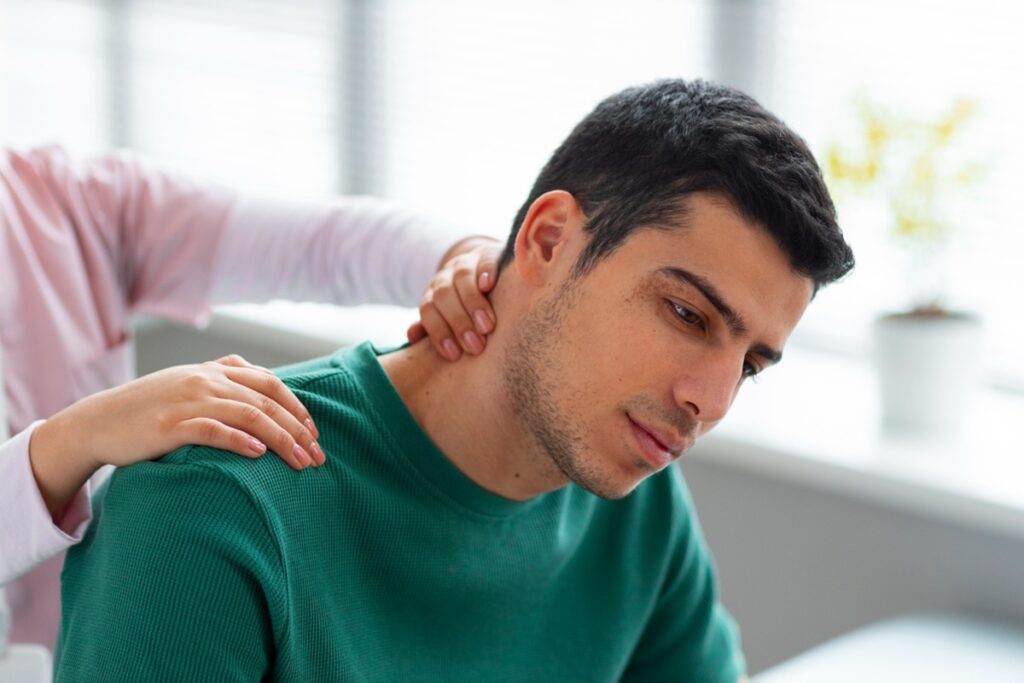
The first step is to settle the irritation. Hands-on therapy helps here, whether that is dry needling, soft-tissue work, or gentle hands-on movement of the neck vertebrae, and mobilizing a stiff or painful upper back often reduces neck pain too. This is well supported: the clinical practice guidelines for neck pain recommend manual therapy and exercise to decrease pain and improve function. Hands-on work is a valuable start to neck arthritis treatment, but it is the opening move, not the whole game.
Key 2: Restore Mobility
Pain and stiffness travel together. As we ease the pain and reduce tension through the neck and upper back, mobility usually improves, and the next job is to make those gains stick with specific exercises. These target the muscles of the spine, core, and shoulders, and restoring t-spine mobility is especially high-yield, since a stiff mid-back forces the neck to compensate. Locking in mobility is the bridge in neck arthritis treatment between short-term relief and lasting change.
Key 3: Build Strength
The most durable part of neck arthritis treatment is building strength and capacity. Once pain is under control and the right muscles engage, we develop strength and durability with load. Done with good technique, rows, push-ups, Turkish get-ups, and other pushing and pulling movements build the upper-body and postural strength that protects the neck and helps prevent flare-ups down the road. A strong, well-supported neck simply tolerates daily life far better than a weak one. That capacity is the part of neck arthritis treatment people most often skip, and it is the difference between a brief quiet spell and lasting relief.
When to Get It Checked First
Most neck arthritis is safe to work on, but a few symptoms warrant prompt medical evaluation. See a provider quickly if you have pain, numbness, tingling, or weakness running down the arm (possible nerve involvement, called radiculopathy), or if you notice hand clumsiness, dropping objects, balance or walking changes (possible pressure on the spinal cord, called myelopathy). These are the exceptions where imaging and a medical workup come before a self-care plan, and ruling them out is simply the first step of safe neck arthritis treatment.
Frequently Asked Questions
Does arthritis on my neck MRI mean I’ll always hurt?
No. Arthritic changes are extremely common in people with no pain at all, so the scan is one piece of the puzzle, not a life sentence. Many people with significant changes on imaging feel great with the right plan, and good neck arthritis treatment leans on that fact rather than on the scan.
Can physical therapy reverse neck arthritis?
It does not reverse the structural changes, and honestly, it does not need to. Effective neck arthritis treatment reduces pain and improves mobility and strength so you function well, regardless of what the X-ray shows.
Do I need surgery for neck arthritis?
Rarely. The vast majority of neck arthritis is managed conservatively with exercise and hands-on care. Surgery is reserved for specific nerve or spinal-cord problems, which is why the red flags above matter.
Will exercise make it worse?
Done sensibly, no. Appropriate, progressive exercise is a core, recommended part of neck arthritis treatment and tends to reduce pain rather than provoke it. A good plan starts where you are and builds gradually, so you gain confidence and capacity at the same time instead of flaring the neck and losing ground.
Feel Better in Greenville, SC
Addressed with a thorough assessment and the right plan, overcoming neck arthritis is very achievable, while ignoring it tends to let the pain linger. If you have neck pain and were told you have arthritis, the physical therapists at Movement Solutions in Greenville, SC would be glad to help. Explore our neck pain resources to start.
Prefer to ask questions first? We also offer a free 15-minute phone consultation to talk through your options before you commit. Call us at (864) 558-7346 and ask how we can help.
Medically reviewed by Dr. Tim Varghese, PT, DPT · Last updated August 21, 2026

Dr. Tim Varghese, PT, DPT
Dr. Tim Varghese, PT, DPT, is the founder of Movement Solutions Physical Therapy in Greenville, SC. He earned his Doctor of Physical Therapy from the Medical College of Georgia and is a Board-Certified Orthopedic Clinical…
More about Dr. Tim →