
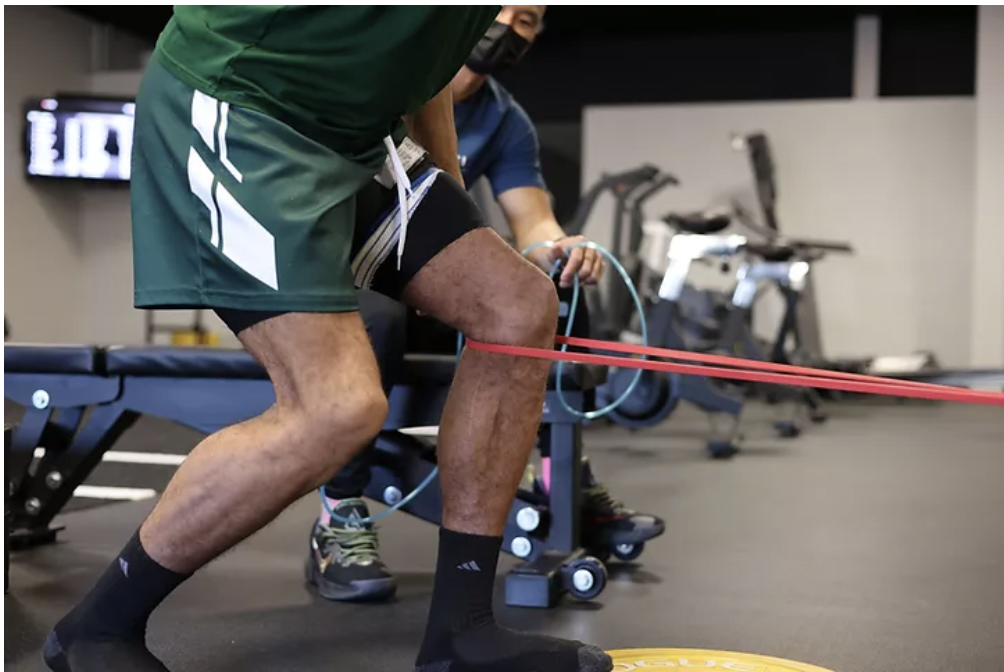
Weak knees can make everyday activities like climbing stairs, squatting, or playing with your kids feel challenging and unstable. Many people assume that knee weakness is simply a result of aging or mild arthritis that must be accepted. However, in many cases, the issue lies not within the knee joint itself but in the surrounding muscles that provide support and stability. Knees naturally weaken with age, but targeted strengthening exercises can improve muscle function to restore confidence and reduce discomfort. This article outlines a simple 3-step exercise progression for weak knee joints that you can start at home, explaining what knee weakness really means, which muscles are most important, and how to safely build strength and function. You’ll also learn when it’s best to seek professional guidance.
What “Weak Knees” Usually Mean (and What They Don’t)
When people say they have weak knees, they usually mean the muscles around the knee and hip are not doing their job. The joint itself is not “falling apart.” Even people with normal X-rays or mild arthritis can feel weakness if the surrounding muscles are not strong or coordinated enough to stabilize the knee joint during movement.
“Weak” can mean different things. It might be fatigue or shakiness during activity. Sometimes, a feeling of the knee “giving way” can result from pain inhibition, true ligament instability, or, less commonly, nerve-related weakness. If your knee truly buckles repeatedly without pain, or if you experience foot drop or numbness, this indicates a different issue that requires a tailored approach.
Here is what muscle weakness around the knee often looks like:
- – Feeling unstable on stairs, especially going down
- – Difficulty standing from low chairs or the floor
- – Knees shaking or feeling tired during squats
- – Needing to grab the handrail or use your hands to push up
- – A sense that the knee might “give way” during walking or hiking
This is usually not a torn ligament or “bone-on-bone” arthritis, and it does not always require surgery. For many common, non-emergency knee issues, progressive strengthening and guided rehabilitation can reduce pain and improve function, and surgery is not always the first step.
If you had a sudden injury with a pop, cannot bear weight, or have big immediate swelling, that is worth getting checked right away. But gradual weakness that creeps up over time is a different situation, and one that often responds well to the right exercise routine.
Simple Knee Anatomy: How the Joint Stays Strong and Stable
The knee is a hinge joint. It sits between the thigh bone (femur) above, the shin bone (tibia) below, and the kneecap (patella) in front. Ligaments and cartilage guide and cushion the joint, but day-to-day stability comes from the leg muscles that surround it.
Here are the main players:
- – Quadriceps: The big muscle group on the front of your thigh. It straightens your leg and controls how you lower down into a squat or step.
- – Hamstrings: These run along the back of your thigh and help bend the knee and control forward motion.
- – Glutes: The hip muscles. When they are weak, the knee tends to cave inward during walking, running, or squatting.
- – Calves: Below the knee, these help with push-off and absorb force when you land.
When these muscles are strong and fire at the right time, they act like shock absorbers for the knee joint. This matters whether you are walking around Greenville, SC, climbing stairs, lifting at work, or running trails.
If your foot collapses a lot and your knee caves in during single-leg tasks, footwear, foot strength, and hip control may matter. This is a practical area to address, but not every knee issue involves foot pronation.
When the hip muscles are weak, the knee often drifts inward during single-leg tasks. This puts extra stress on the inside and front of the knee, which can lead to irritation and pain over time.
Why Knee Joints Start to Feel Weak
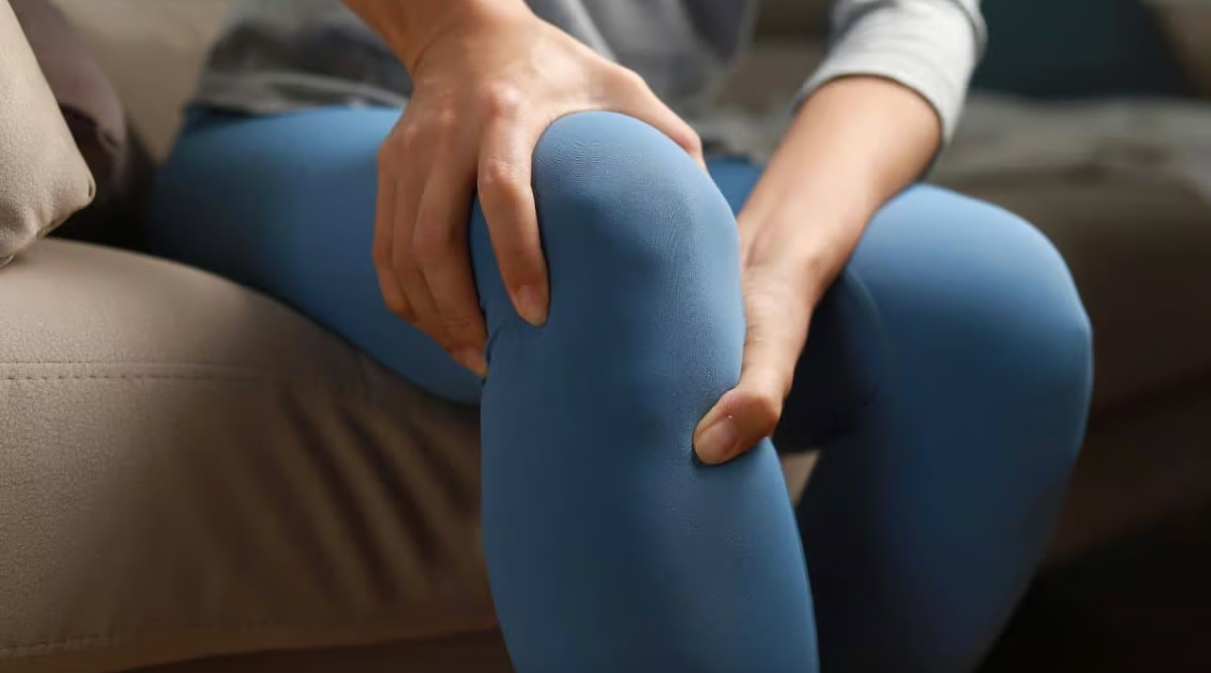
In the clinic, we see a few patterns come up again and again. Here are the big things that usually drive knee weakness:
- – Inactivity or long breaks from exercise. Desk jobs, long car commutes, or a post-holiday slowdown can lead to loss of strength in the quads and glutes. Muscles that are not used regularly get weaker.
- – Previous injury or surgery. After an ACL tear, meniscus surgery, or patellar tendon issue, swelling and rest often lead to lost muscle size. Confidence in the joint takes a hit too, which makes people move less.
- – Repetitive overload. Running hills, high-volume squats, or a sudden jump in activity without enough recovery can cause pain and muscle “shut down.” Overuse injuries are common when training ramps up too fast.
- – Hip and core weakness. When the core muscles and glutes are not strong, the knees have to work overtime to control twisting and side-to-side motion. This is especially noticeable on trail hikes or single-leg movements.
- – Age-related changes or early arthritis. The joint may be more sensitive, but smart strength work still often improves function and decreases pain. Knee arthritis is a leading cause of chronic disability among adults in the United States.
Footwear, training surfaces, and balance problems can also make the knees feel less secure. These are worth addressing, but muscle weakness is usually the bigger issue.
3-Step Progression: Weak Knee Joints Exercise Plan at Home
This is a practical, 3-step progression designed for home. It moves from supported and easy to more functional and challenging.
Most people in Greenville, SC can start at Step 1 and move to the next step when the exercises feel too easy and pain stays at a mild level or less.
Here is the general guideline: Aim for three sets of 10 to 15 repetitions of each exercise to strengthen weak knees. Focus on slow, smooth movement and no sharp pain.
Pain rule: 0–3/10 discomfort during exercise is usually okay if it settles by the next day. Sharp pain, swelling, or worsening symptoms means scale back or stop and consult a professional.
Progression criteria: Move to the next step when you can do 3 sets of 12–15 reps with good control and no next-day flare-up.
Tempo and range: Use a slow 3-second lowering phase and start with a small range of motion, increasing as control improves.
You only need bodyweight, a sturdy chair, a step, and a light resistance band. Most people already have these at home.

Step 1: Gentle Activation for Very Weak Knees
This step is for knees that feel very weak, achy, or unsteady. It is also a good starting point for the first week after a flare-up.
Exercise 1: Quad Set
Lie on your back or sit with your leg straight. Tighten the front of your thigh to gently press the back of your knee toward the floor. You can place a rolled towel under your knee for feedback. Hold 5 to 10 seconds, then relax. Repeat 10 to 15 reps per side.
Exercise 2: Straight Leg Raise
Lie on your back with one knee bent and the other leg straight. Keep your toes pointed up. Tighten the thigh of the straight leg and slowly lift it 12 to 18 inches off the floor. Hold for a few seconds, then slowly lower it back down. Repeat 10 to 15 reps, then switch sides.
Exercise 3: Side-Lying Hip Abduction
Lie on your side with your bottom knee bent for stability. Keep your top leg straight. Slowly lift your top leg like a slow side kick, keeping your toes pointing forward. Do not let your hip roll backward. Slowly lower and repeat.
Sets and reps: 2 to 3 sets of 10 to 15 reps each exercise, 4 to 5 days per week.
Swimming and water aerobics are excellent low-impact options to support knee activation and reduce joint stress during this stage.
You should feel muscle effort and mild fatigue, but no sharp, catching, or buckling pain. If that happens, ease off and consider a professional check.
Step 2: Building Strength and Control Around the Knee
Move to this step when Step 1 feels easy and daily tasks like flat walking are comfortable, but stairs or squats still feel challenging.
Exercise 1: Sit-to-Stand from Chair
Use a sturdy chair with your feet flat on the floor, about feet hip width apart. Lean slightly forward, then stand up using your legs. Sit back down with control. You can cross your arms or lightly support your thighs as needed.
Exercise 2: Wall Squat Hold
Stand with your back against a wall, feet about 18 to 24 inches away, feet shoulder width apart. Slide down into a small mini-squat. Keep your knees in a straight line over your toes and avoid letting them move past your toes. Hold 10 to 20 seconds, then slowly rise back up.
Exercise 3: Heel Raises at Counter
Stand tall holding a countertop for support. Lift your heels to stand on your toes, then slowly lower back down. Focus on calf strength and keeping your knees stable.
Sets and reps: 3 sets of 8 to 12 reps (or holds) per exercise, resting 30 to 60 seconds between sets.
As confidence improves, try a slightly lower chair, longer wall squat holds, or single-arm support at the counter. Progress from bodyweight exercises to adding light ankle weights as movements become easier.
Step 3: Functional Strength for Hiking, Running, and Sport
This step is for when daily life feels mostly good, and you want to return to running on the Swamp Rabbit Trail, hiking, pickleball, or gym work in Greenville, SC.
Exercise 1: Step Ups
Use a 6 to 8 inch step or sturdy platform. Plant your whole foot on the step, drive through your heel to stand up, then slowly lower back down. Focus on keeping your knee aligned over your second or third toe, and avoid letting it cave inward.
Exercise 2: Reverse Lunges or Split Squats
Step one foot back into a comfortable lunge depth, with your knees bent. You can hold a countertop for balance. Slowly bend and slowly lower into the lunge, then push back to the starting position. Repeat on the other leg.
Exercise 3: Single-Leg Balance with Mini Knee Bend
Stand on one foot near a counter for safety. Do a small, controlled knee bend, then straighten. Focus on keeping your knee in line with your toes. Switch sides after your reps.
Sets and reps: 2 to 3 sets of 6 to 10 reps per leg, focusing on good form, slow tempo, and no loss of control or knee collapse inward.
Once the basics feel solid, you can add a light resistance band around your thighs or hold light weights in your hands to increase the challenge.
Lateral walks help enhance stability by improving side-to-side strength and proprioception. Tai Chi and yoga improve balance and flexibility with modifications. Cycling is beneficial for building strength without impact.
What You Can Do Today If Your Knees Feel Weak
Here is a quick-start checklist to begin strengthening your weak knees:
- – Pick your step (1, 2, or 3) based on how your knees feel now.
- – Choose 2 to 3 exercises from that step.
- – Commit to a short daily routine. Even 10 to 15 minutes helps.
A few more tips:
- – Always warm up first. 3 to 5 minutes of easy marching in place or a short neighborhood walk helps prepare the muscles.
- – Use pain as a guide. Slight discomfort during exercise is okay. Sharp pain, big swelling, or a feeling that the knee might give out is a sign to stop and modify.
- – Cool down after. 5 to 10 minutes of gentle movement and possibly ice if the knee feels warm or irritated.
- – Track progress by the week, not the day. Notice how stairs, squats, and long walks feel over time.
- – Keep a simple log. Write down sets, reps, and how your knees feel. This helps you see trends and know when to progress.
- – Aim for 3-4 strength training sessions per week for improving knee strength.
How Physical Therapy Helps Weak Knees Get Stronger
Physical therapy builds on home exercises with more precision and support. At Movement Solutions Physical Therapy, we start with a detailed evaluation. This includes your history of activities and injuries, watching how you squat, walk, step, and balance, and testing specific muscle strength around the hip, knee, and ankle.
PT sessions often include:
- – Targeted strengthening for the quadriceps, hamstrings, and glutes, including hamstring curls performed by bending one knee and bringing the heel toward the glute while holding onto a chair for balance.
- – Mobility work for joints that are stiff or limited.
- – Balance training for single-leg stability.
- – Coaching on squat, lunge, and step technique with proper form, emphasizing avoiding common mistakes like knee cave, heel lift, or trunk sway.
Hands-on work can also help when tissues are irritated. This might include soft tissue work, joint mobilization, or taping to calm things down so exercise feels safer.
An individualized plan is especially helpful for people who have tried knee exercises from the internet without lasting improvement. Patients in Greenville, SC often appreciate having a clear, written plan with progressions laid out so they know exactly what to do between visits.
Regularly performing physical therapy exercises for knee strengthening 3-4 times per week is crucial to seeing and maintaining results.
What To Expect: Timeline and Signs Your Knees Are Getting Stronger
| Timeframe | What You Might Notice |
|---|---|
| 2 to 3 weeks | Early improvements in confidence, less stiffness, easier sit-to-stands |
| 6 to 8 weeks | More obvious strength gains, smoother squats, less fatigue on longer walks |
| 3 months or more | Muscle size and endurance changes, return to running or heavier gym work |
Early wins (2–3 weeks)
- – Easier sit-to-stands from chairs
- – Less soreness after walking downtown
- – Less need to pull on the railing for stairs
Strength phase (6–8 weeks)
- – Improved balance on one leg
- – Smoother, more confident squats
- – Tolerance for longer hikes or workouts without the knees feeling “tired”
Return to higher demand (3+ months)
- – Muscle size improvements
- – Endurance for running, hiking, or heavy lifting
- – Confidence to return to sports like pickleball or trail running
Try tracking a few specific tasks. How many sit-to-stands can you do in 30 seconds? How many stairs can you climb before your knees feel shaky? This gives you clear data on progress.
Progress is rarely a straight line. A small flare-up does not mean damage. It may just mean adjusting volume or asking a physical therapist for help with your plan.
When To See a Professional Sooner About Weak Knees
Most mild knee weakness can be worked on at home. But some signs mean it is smart to get checked sooner rather than later.
See a provider if you notice:
- – New or worsening numbness, tingling, or obvious muscle weakness in your leg or foot
- – A sudden injury with a pop, immediate big swelling, or inability to put weight on the leg
- – The knee feels hot, very swollen, or you also have a fever or feel unwell
- – Locked knee or inability to fully straighten the leg
- – Repeated true buckling without pain
- – Unexplained weight loss, night pain that does not change with position, or a history of significant medical issues
- – Bowel or bladder changes combined with leg weakness (this can be a sign of serious back issues like cauda equina syndrome and needs urgent medical attention)
These are not meant to scare you. They are just clear signals that professional eyes can help sort out what is going on.
Ready for More Support? Working With a Local Knee Specialist
Dealing with weak knees can be frustrating, especially when you want to stay active and independent. At Movement Solutions Physical Therapy in Greenville, SC, we help active adults with weak or painful knees get back to the activities they care about. That starts with understanding what is driving the problem and building a plan that fits your goals.
If your knees are holding you back and you are not sure what to do next, reach out. We can talk through a plan that fits your situation. You can schedule an evaluation or just ask a question by phone or through our contact form.
Both in-person and virtual options are available for people in and around Greenville, SC.
Weak knees usually have a path forward when strength, movement, and recovery are handled with a plan. The exercises in this article are a solid place to start. And if you need more guidance, we are here to help.
