
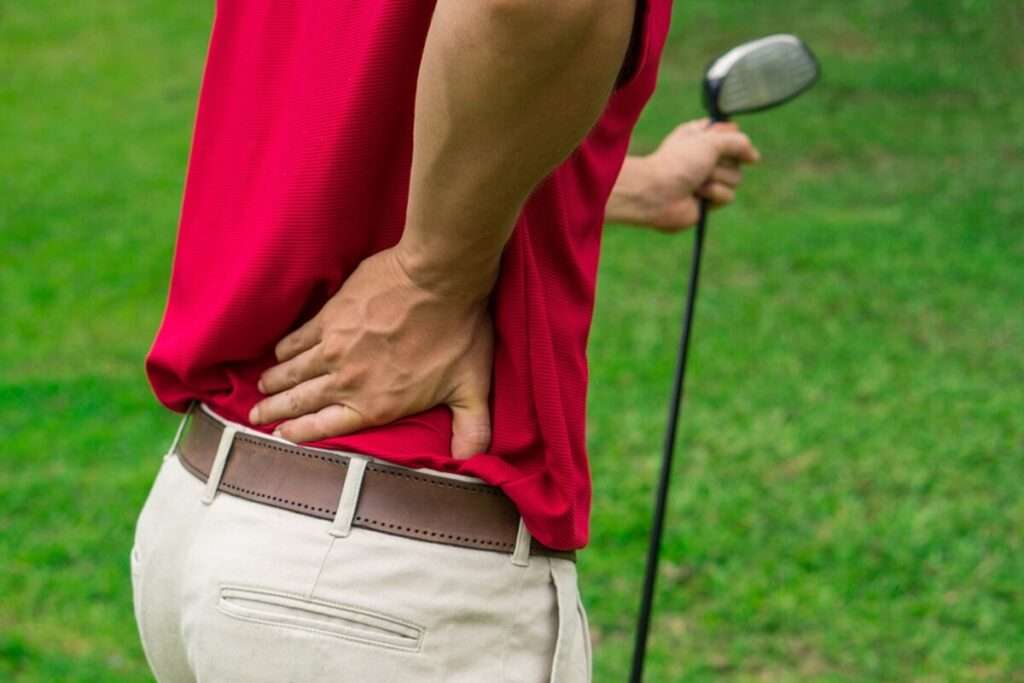
Golf back pain is one of the most common complaints we hear from golfers, and it can quietly wreck an otherwise great round. Low back pain is a common problem among golfers, and it can show up at the base of the spine, down or across the spine, in the muscles alongside it, or even radiating down a leg. Common diagnoses linked to low back pain include degenerative disc disease, disc herniations, sciatica, and lumbar strains. The good news is that most golf back pain is very manageable, and this guide covers what causes it and five fixes to get you swinging pain-free.
What Causes Golf Back Pain?
An exam is the only way to get an accurate diagnosis, but the drivers of golf back pain are remarkably consistent. The biggest one is swing mechanics. Many golfers do not know how to rotate through their hips and upper back, and they struggle to engage their hip and glute muscles. When that happens, they over-twist at the lower back, and over time that repetitive strain causes problems.
Mobility is the other major factor. Golf back pain is often tied to poor mobility of the hips and the mid-back (t-spine), combined with weakness in the abdominal and lower back muscles. In fact, research on golfers links back pain to limited hip mobility, trunk rotation, and strength: when the lead hip cannot rotate well, the lumbar spine picks up the slack and pays the price. A movement assessment is the best way to pinpoint which of these is driving your pain.
5 Fixes for Golf Back Pain
Here is the step-by-step approach we use to help golfers beat back pain and keep it from returning.
1. Calm the Flare
If your lower back is irritated, the first move is a short break from golf so the area can settle and heal. Hands-on therapy can ease pain and improve mobility, and you can do a version of this yourself with a foam roller or lacrosse ball. For a stubborn flare, dry needling of the lower back muscles helps, and for a recent injury, spinal manipulation can have a powerful effect on pain.
2. Activate the Right Muscles
Once the acute pain settles, retrain the muscles that are not firing well. Reliable beginner exercises include bridges, active straight-leg raises, and the “angry cat.” Waking up the deep core and glutes gives your spine the support it has been missing during the swing. Aim for two sets of eight to twelve slow, controlled reps, and focus on feeling the right muscles work rather than just going through the motions.
3. Restore Your Rotation
Golf is a rotational sport, so your torso and hips need to turn through a full range of motion. Good rotational drills include the trunk-stability rotation for the upper back and the prone lumbar extension-rotation for the lower back. Tall-kneeling rotation with a kettlebell behind the back is excellent for building hip rotation, which is exactly what takes strain off the lumbar spine.
4. Build Rotational Strength
Next, develop strength through both straight and rotational planes. Even golfers benefit from squats, deadlifts, and lunges. Just as important are strength exercises that involve rotation: Turkish get-ups, weighted chops, and weighted lifts help a golfer build a rock-solid back and keep playing for years. Many of these can be found in our video library.
5. Fix Your Swing and Keep Moving
Finally, address the pattern that started it all. Learn to rotate through your hips and t-spine rather than cranking your lower back, and keep the mobility and strength gains above in your routine. This is the difference between quieting golf back pain for a week and solving it for good.
How Long Until You Can Golf Pain-Free?
It depends on how long the pain has been building and how much of the underlying weakness and stiffness you address. Many golfers feel meaningfully better within a few weeks of calming the flare and starting the right mobility and activation work. Building the rotational strength that keeps golf back pain away usually takes a couple of months. Progress tends to come in stages: first, less pain during and after your round, then more distance and control as your hips and t-spine move the way the swing demands. Treat it as an ongoing habit rather than a one-time fix, and your back keeps up with your game.
Frequently Asked Questions
Should I stop golfing if my back hurts?
A short break during a flare is smart, but long-term rest usually is not the answer. Once the pain settles, the fix is restoring mobility and building strength so you can return to golf, not avoid it forever. Sharp or radiating pain, though, deserves an assessment first.
Does hip mobility really affect golf back pain?
Yes, significantly. When your lead hip cannot rotate well, your lower back over-rotates to make up the difference, and that repetitive twist is a leading cause of golf back pain. Improving hip and t-spine mobility is one of the highest-value changes a golfer can make.
What are the best exercises for golf back pain?
A blend works best: core activation like bridges and dead bugs, rotational drills like tall-kneeling kettlebell rotations, and rotational strength like chops and Turkish get-ups. The right mix depends on your specific limitations.
Get Back to Pain-Free Golf in Greenville, SC
When addressed with a specialized physical therapy program, playing golf without back pain is absolutely possible. Ignoring the problem and swinging through it, on the other hand, can lead to a further decline in your back health. If you are worried about your back pain, the physical therapists at Movement Solutions in Greenville, SC would be glad to help.
We invite you to request a back consultation with one of our specialists. It is a chance to ask questions, get clarity about your back pain, and build confidence that we can help.
If you are in pain but unsure what to do, call us at (864) 558-7346 and ask how we can help.
Medically reviewed by Dr. Tim Varghese, PT, DPT · Last updated August 14, 2026

Dr. Tim Varghese, PT, DPT
Dr. Tim Varghese, PT, DPT, is the founder of Movement Solutions Physical Therapy in Greenville, SC. He earned his Doctor of Physical Therapy from the Medical College of Georgia and is a Board-Certified Orthopedic Clinical…
More about Dr. Tim →