
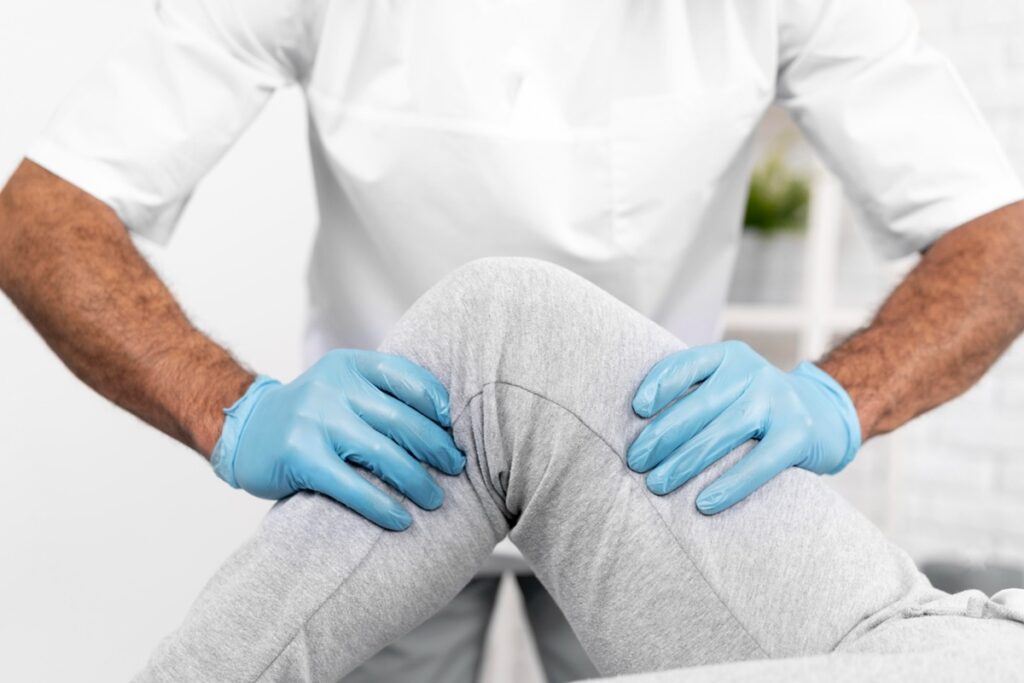
If a scan just showed a meniscus tear, take a breath before you book an operation, because recovering from a torn meniscus without surgery is realistic for most people. The meniscus is a pair of C-shaped cartilage cushions in each knee that sit between your shinbone and thighbone. A tear can cause pain, swelling, and stiffness, and it often flares with walking, stairs, squatting, and lunging. The encouraging part is that the great majority of tears calm down and get strong again without an operation.
Step 1: Know That Most Tears Don’t Need Surgery
This is the fact that changes everything about pursuing a torn meniscus without surgery. Research has repeatedly shown that “clean-up” arthroscopic surgery for common degenerative tears is no better than the alternatives. In a landmark trial, the New England Journal of Medicine published a study showing that surgery for a degenerative meniscus tear was no better than a fake (sham) operation. And when researchers compared surgery head-to-head with exercise, a 10-year follow-up found exercise therapy worked just as well as arthroscopic surgery, while building more thigh strength along the way.
Step 2: Calm the Knee Down
The first practical move is a short period of relative rest from the activities that aggravate the knee, usually twisting and full-depth knee bends. Easing off those lets the inflammation settle so healing can begin. If pain lingers, hands-on therapy can be very effective; for meniscus injuries, gentle joint “gapping” during bending and straightening is often a powerful way to reduce pain.
Relative rest is not the whole plan for a torn meniscus without surgery, but it buys you a calm window to fix what caused the problem. In the meantime, stay as active as the knee allows with low-twist options like straight-line walking, cycling, or pool work, since total rest tends to weaken the very muscles that a torn meniscus without surgery ultimately depends on.
Step 3: Restore Hip and Ankle Mobility
A calmer knee is the time to address the root causes that overloaded the meniscus in the first place. Very often, the knee is the victim of stiffness above and below it. Restoring hip mobility and ankle mobility takes the twisting stress off the knee, so the joint stops paying for what the neighbors cannot do. This step is a quiet workhorse in recovering from a torn meniscus without surgery.
Step 4: Rebuild Quad, Hamstring, and Glute Strength
Weakness of the quadriceps, hamstrings, and glutes changes how the knee tracks and loads, so rebuilding it is central to a torn meniscus without surgery. We usually start with activation drills to wake up muscles that are not firing, then progress into strengthening. Pairing hip and core strength with knee strength is what corrects the faulty mechanics that set up the tear, and it is the same principle behind how to strengthen your knees in general.
Step 5: Return to Loading
Here is the payoff. The movements that hurt early on now become your medicine. Once your knee is calm and your muscles engage well, you retrain the functional movement patterns and gradually load them. Squats, deadlifts, and lunges, built up sensibly, develop the strength that keeps the pain from returning. Progressive loading is what turns a torn meniscus without surgery from “pain-free for now” into “durable for the long haul.”
When Surgery Should Be on the Table
Honesty matters here. The strong no-surgery evidence applies to degenerative and small tears, which are the common kind. Some situations do call for a prompt orthopedic opinion: a knee that is truly locked or cannot fully straighten, a large or “bucket-handle” tear, or an acute tear from a significant twisting injury, more often in younger, athletic knees. A good assessment helps sort out which camp you are in, and even then the decision is one to make with your medical team rather than by default.
Frequently Asked Questions
Can a torn meniscus heal without surgery?
Symptoms from most degenerative and small tears settle very well with rehab even when the cartilage itself does not fully “close,” which is why a torn meniscus without surgery is the usual starting point. High-quality trials show surgery often adds no benefit over exercise for these tears.
How long does recovery take?
Many people feel meaningfully better within several weeks to a few months of consistent mobility and strengthening work, though it varies with the tear and your goals. Sticking with the loading plan, even after the pain eases, is what makes the result last, and it is the part of a torn meniscus without surgery that people most often rush.
Will I make the tear worse by exercising?
Not with the right, progressive plan. Guided loading is protective, not harmful, for typical degenerative tears. Sharp, worsening pain, locking, or a knee that gives way are signs to get reassessed rather than to push through. Guided, gradual loading is the safest engine behind a torn meniscus without surgery.
Do I need an MRI first?
Not always. Meniscus changes show up on imaging in plenty of pain-free knees, so a scan is one piece of the picture, not the whole story. A hands-on assessment often tells us more about what is actually driving your pain. That said, if your knee truly locks or your symptoms do not fit the usual pattern, imaging can help rule out the kind of tear that needs a surgeon’s eye.
Get Back to Activity in Greenville, SC
When it is addressed with a specialized physical therapy program, most meniscus tears resolve relatively quickly, and ignoring the pain and pushing through only tends to cause bigger problems. If you want to overcome a torn meniscus without surgery, the physical therapists at Movement Solutions in Greenville, SC would be glad to assess your knee and build your plan.
Prefer to ask questions first? We offer a free 15-minute phone consultation to talk through your options before you commit to anything. Call us at (864) 558-7346 and ask how we can help.
Medically reviewed by Dr. Tim Varghese, PT, DPT · Last updated August 21, 2026

Dr. Tim Varghese, PT, DPT
Dr. Tim Varghese, PT, DPT, is the founder of Movement Solutions Physical Therapy in Greenville, SC. He earned his Doctor of Physical Therapy from the Medical College of Georgia and is a Board-Certified Orthopedic Clinical…
More about Dr. Tim →