
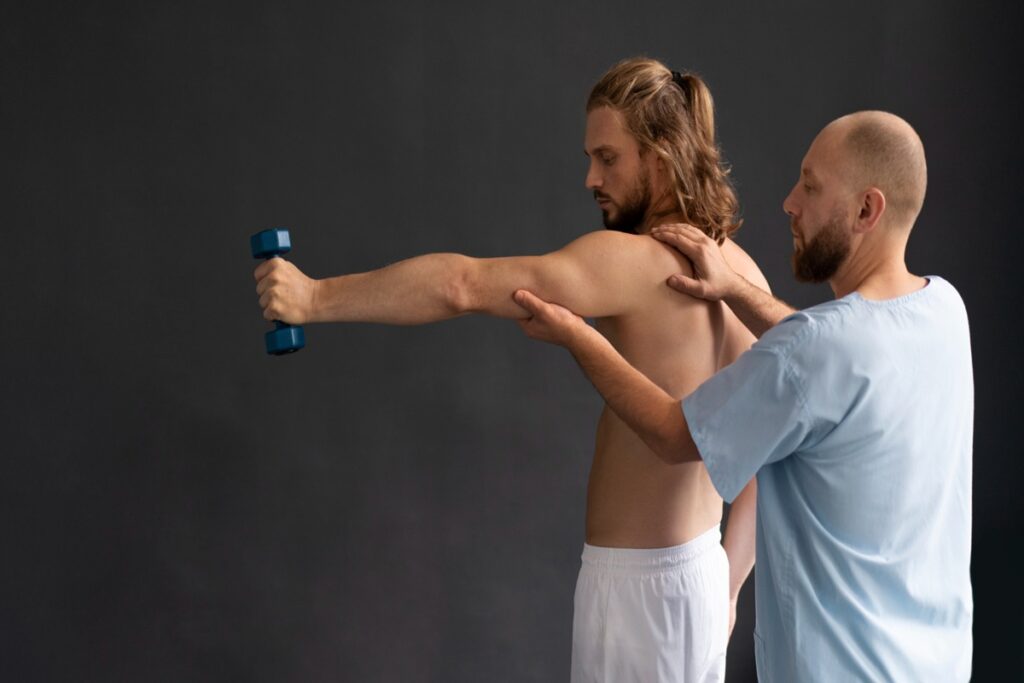
If you want to protect your shoulders for the long haul, learning how to improve shoulder mobility is the best place to start. Almost everyone will experience shoulder pain at some point, and how well your shoulder moves has a lot to do with whether it stays healthy or starts to hurt. This guide walks through five steps to improve shoulder mobility and then build the stability and strength that make those gains last.
Why Shoulder Mobility Matters
Rotator cuff tendinitis, rotator cuff tears, biceps tendonitis, labral tears, shoulder instability, and impingement are some of the most common shoulder conditions we see at Movement Solutions. Many of them share the same background risk factors, and near the top of that list is limited mobility at the thoracic spine (upper back) and lats.
This is not just clinical hunch. Research shows that people with rotator-cuff-related shoulder pain have significantly less thoracic rotation than pain-free individuals. When the upper back and lats are stiff, the shoulders round forward and rotate inward, overhead capacity drops, and loading the arm in that position grinds on sensitive structures like the rotator cuff, biceps tendon, and labrum. That is exactly why the first move to improve shoulder mobility is usually higher up the chain than the shoulder itself.
Step 1: Find the Real Drivers
Before you chase the shoulder, look at what feeds it. Beyond the thoracic spine and lats, weakness of the core and glutes changes how an active person moves, and movement errors (like failing to “pack” the shoulder when pressing overhead) can set up an injury. A quick self-check: if you cannot reach overhead without arching your low back, or your shoulders sit rounded forward at rest, those are the patterns to address first. Knowing your own limiters makes every effort to improve shoulder mobility far more effective.
Step 2: Free Up the T-Spine and Lats
The first step we often take to reduce pain and improve shoulder mobility is hands-on work: soft-tissue mobilization, joint mobilization or manipulation, and sometimes dry needling. You can reinforce those effects at home with foam rolling. By applying pressure through tense, stiff muscles, you release tension and open up motion. Two of our go-to drills are foam rolling the t-spine and the lats.
For a full mid-back routine, see our guide on t-spine mobility, which pairs perfectly with this work.
Step 3: Activate and Strengthen the Weak Links
Here is the catch: foam rolling alone will not give you lasting gains. Stiffness and tension are usually driven by weakness, both of the tight muscle itself and of the muscle groups above and below it. Moreover, your body has to learn to actively use the range it gains through passive tools like manual therapy and foam rolling. To truly improve shoulder mobility for good, the inactive muscles have to be woken up and strengthened. These are a couple of the exercises we use to target those weak regions.
Step 4: Build Stability by Packing the Shoulder
Once you have improved and reinforced mobility, the next job is stability. Shoulder stability begins with scapular depression, or “packing” the shoulder blade. Packing protects the sensitive tissues that run along the head of the humerus when you load the shoulder. You can practice it with a partner or with a mobility band. Mobility without stability is a shoulder that moves well but cannot control that motion under load, so this step is what turns new range into a resilient shoulder. It is also what lets your work to improve shoulder mobility actually stick.
Step 5: Own It Under Load With the Kettlebell Arm Bar
If you have good mobility and stability in static positions but your shoulder still complains when you actually move, the program is not done. You have to teach the shoulder to use its mobility and stability dynamically. One of the best exercises for this is the kettlebell arm bar.
We like kettlebells because their off-center mass challenges stability. Performed with good technique, arm bars build strength through the shoulder girdle (serratus anterior, lats, and lower trapezius). It takes coaching and practice to keep the shoulder steady under load, but it is a skill worth mastering, because it carries over to every press and pull you do, from the military press to hoisting the holiday decorations back into the attic. This is the final piece that lets you improve shoulder mobility and actually put it to use.
Prevention vs. Working Through Pain
In the absence of pain or injury, the five steps above are an excellent way to improve shoulder mobility and prevent problems before they start. If your shoulder already hurts, though, a more nuanced approach is needed, because pain changes movement. Compensations have to be identified through an assessment, and an individualized plan built to correct them. Manual therapy is often worth considering when pain and mobility restrictions are both present, followed by a carefully progressed exercise plan. The good news is that the evidence strongly supports this route: a systematic-review update found exercise therapy is a first-line treatment that improves pain, mobility, and function for common shoulder pain.
Frequently Asked Questions
How long does it take to improve shoulder mobility?
Many people feel looser within a couple of weeks of consistent work, especially once soft-tissue tightness eases. Lasting change, the kind that holds under load, usually takes one to three months of pairing mobility drills with the strengthening and stability work above.
Can I improve shoulder mobility at home?
Often, yes. Foam rolling the t-spine and lats, activation and strengthening drills, shoulder packing, and a loaded carryover exercise can go a long way for a generally stiff, healthy shoulder. If you have pain, numbness, weakness, or a history of dislocation, get assessed before loading the shoulder.
Is stiffness or weakness the bigger problem?
Usually both, and they feed each other. Stiffness is often driven by weakness in the surrounding muscles, which is why foam rolling alone does not last. Combining mobility with strengthening is what makes the difference.
Move and Feel Better in Greenville, SC
If you live in Greenville, South Carolina, are active (or want to be), are in your 40s to 60s, and have shoulder pain, the providers at Movement Solutions would be glad to help. We are happy to start with a free phone consultation with one of our providers, where we can talk through your options and how to get your life back.
If you are unsure where to start, call us at (864) 558-7346 and ask how we can help.
Medically reviewed by Dr. Tim Varghese, PT, DPT · Last updated August 21, 2026

Dr. Tim Varghese, PT, DPT
Dr. Tim Varghese, PT, DPT, is the founder of Movement Solutions Physical Therapy in Greenville, SC. He earned his Doctor of Physical Therapy from the Medical College of Georgia and is a Board-Certified Orthopedic Clinical…
More about Dr. Tim →