
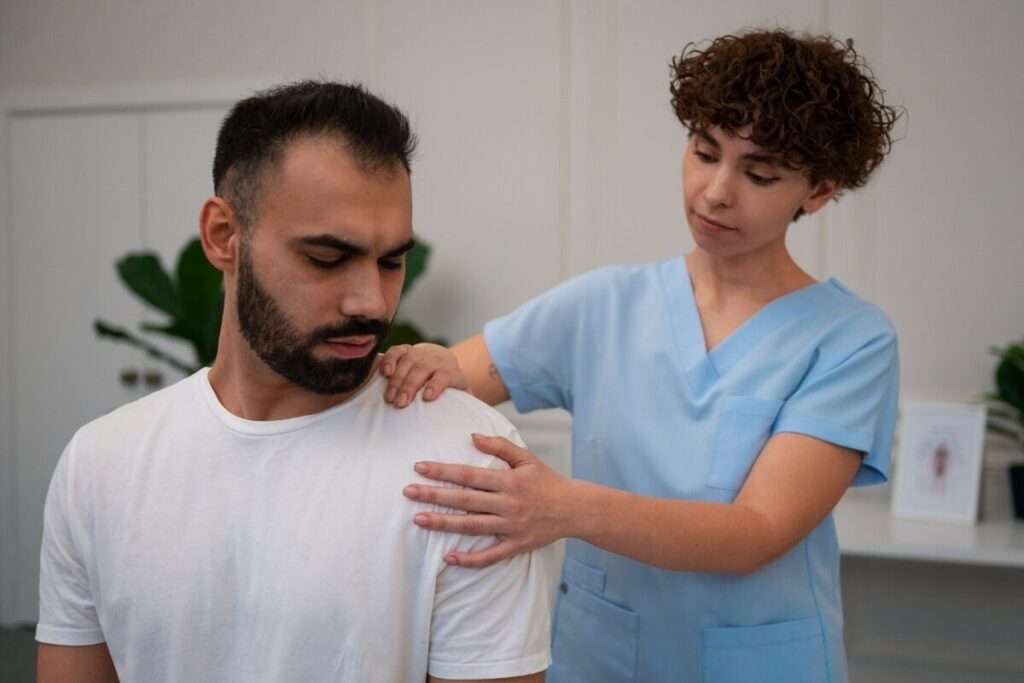
Rotator cuff surgery recovery is a marathon, not a sprint, and the people who do best are the ones who respect the timeline and follow a clear, phased plan. Many of our clients first come to us hoping to overcome a rotator cuff tear without surgery, but when a tear is severe enough, a repair is the right call. If that is you, this guide walks through the four phases of rotator cuff surgery recovery so you know what to expect and how to protect your result.
Rotator cuff surgery recovery moves through four phases. The arm is usually in a sling for about 4–6 weeks, with physical therapy typically running 4–6 months:
| Phase | Focus |
|---|---|
| 1. Maximal protection (weeks 1-6) | Protect the healing repair; arm stays in a sling, with help needed for daily tasks |
| 2. Moderate protection | Less sling time; restore mobility, add shoulder-blade and trunk strengthening |
| 3. Return to activity | Rebuild strength and joint awareness; cleared for daily activities |
| 4. Return to work & sport | Activity-specific drills to return to sport, lifting, or golf |
Why Rotator Cuff Surgery Recovery Takes Patience
After a repair, the tendon has to heal back to the bone, and that biology cannot be rushed. Tendon-to-bone healing is generally not solid before about 12 weeks, which is exactly why the early phase is so protective. Push too hard too soon and you risk a retear; in fact, more aggressive early rehab has been linked to higher retear rates, especially with larger tears. Go too slow and you can end up stiff. The art of good rotator cuff surgery recovery is matching the pace to your specific repair, which is why your surgeon’s protocol comes first and a skilled therapist tailors the rest.
At Movement Solutions, we specialize in helping active adults in their 40s to 60s who either want specialized care from day one, or tried traditional therapy and got lackluster results. Our program calms pain, restores movement, and rebuilds strength so you can get back to playing with the grandkids, golf, tennis, and lifting.
The 4 Phases of Rotator Cuff Surgery Recovery
A rotator cuff repair rehab program is typically divided into four phases. Here is what each one involves.
Phase 1: Maximal Protection (Weeks 1 to 6)
The first phase protects the healing repair, when the shoulder is most vulnerable. Your arm stays in a sling, and you will need help with everyday tasks like bathing and dressing. Your physical therapist teaches gentle range-of-motion and isometric exercises, provides hands-on treatment such as gentle massage, and gives you strategies to manage pain. The whole goal here is to guard the repair while keeping the joint from getting stiff.
Phase 2: Moderate Protection
Next, the focus shifts to restoring mobility. Time in the sling drops, and range-of-motion and strengthening work become more challenging, adding exercises for the muscles around the shoulder blade and trunk. You can use the arm for daily activities, but heavy lifting is still off limits. Skilled hands-on mobilization during this phase helps bring back the shoulder’s motion.
Phase 3: Return to Activity
Now the aim is to rebuild strength and joint awareness to match your other shoulder. Your shoulder should be cleared for daily activities, though sports, yard work, and strenuous tasks still need a plan of progression. Your therapist advances the rehab with weight training and more challenging movement patterns, and a fitness-oriented program often begins here.
Phase 4: Return to Work and Sport
The final phase gets you back to work, sports, and higher-level activities. During this phase we guide clients through activity-specific drills built around their goals, whether that is lifting weights, playing tennis, or getting back on the golf course. This is where rotator cuff surgery recovery crosses the finish line.
How Long Does Rotator Cuff Surgery Recovery Take?
Plan for a longer arc than most people expect. A sling is usually worn for about four to six weeks, physical therapy typically runs four to six months, and most people reach functional recovery, meaning comfortable daily activities, within four to six months. Full healing and strength can take nine to twelve months. Reassuringly, research comparing early and traditional rehab protocols finds similar long-term outcomes, so there is no need to rush and risk your repair. Steady, guided progress wins.
Tips for a Smoother Recovery
A few habits make a real difference. Set up your home before surgery so daily tasks are within easy reach, since your operated arm will be out of commission early on. Sleep is often the hardest part in the first weeks, and many people rest better semi-reclined in a recliner than flat in bed.
Stay on top of your home exercises, because the small, consistent reps between visits are where much of the progress in rotator cuff surgery recovery actually happens. And keep the big picture in mind: there will be good days and frustrating ones, but the trend over weeks and months is what matters. Leaning on your therapist for reassurance and course corrections keeps rotator cuff surgery recovery on track when motivation dips.
Frequently Asked Questions
When can I take my arm out of the sling?
Usually around four to six weeks, but only when your surgeon clears it, and many people keep the sling on for sleeping a bit longer. The sling protects the repair while the tendon knits to the bone, so this is one timeline worth following exactly.
When can I lift or return to sports after rotator cuff surgery?
Light daily use returns first, but heavier lifting and sports come later, often in the four-to-six-month range and beyond, once strength and control are rebuilt. Your therapist progresses you with activity-specific work so you return safely rather than reinjuring the shoulder.
What helps rotator cuff surgery recovery go smoothly?
Following your protocol, showing up for therapy, doing your home program, and not skipping ahead. A guided, phased plan protects the repair early and builds real strength later, which is the combination that produces a durable shoulder.
Recover Strong in Greenville, SC
With a well-designed, phased plan, a full return to activity after rotator cuff surgery is very achievable. If you have had or are planning a rotator cuff repair, the physical therapists at Movement Solutions in Greenville, SC would be glad to guide your recovery. You can also explore our approach to shoulder pain more broadly.
If you would like help, ask us about availability and cost or call (864) 558-7346 and ask how we can help.
Medically reviewed by Dr. Tim Varghese, PT, DPT · Last updated September 25, 2026

Dr. Tim Varghese, PT, DPT
Dr. Tim Varghese, PT, DPT, is the founder of Movement Solutions Physical Therapy in Greenville, SC. He earned his Doctor of Physical Therapy from the Medical College of Georgia and is a Board-Certified Orthopedic Clinical…
More about Dr. Tim →