
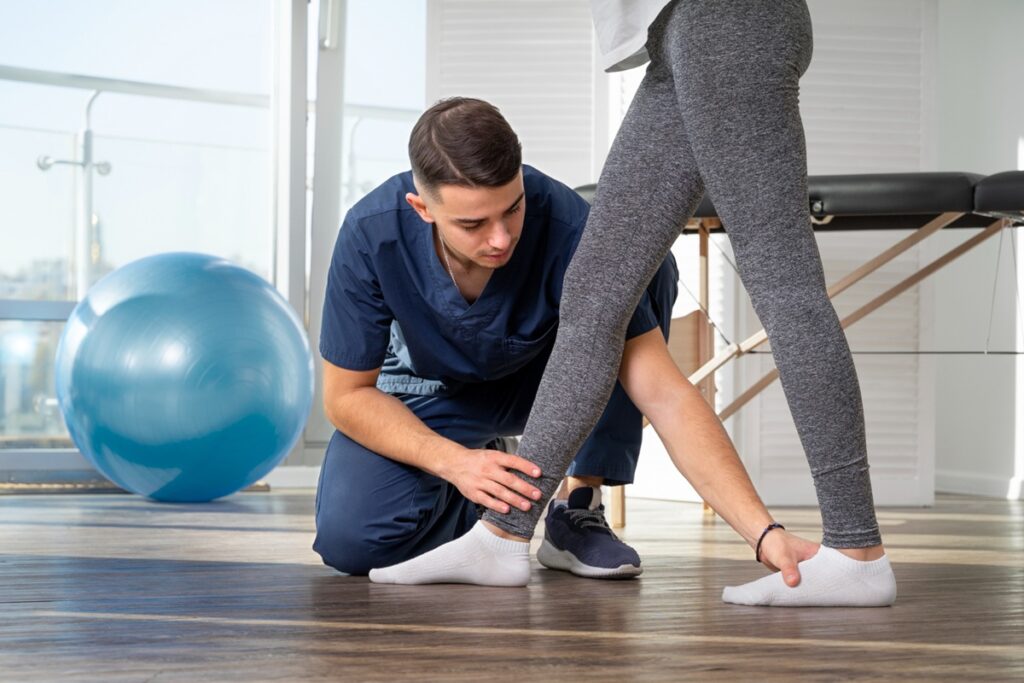
If you want to improve ankle mobility, the payoff reaches far beyond your feet. In order to squat, lunge, walk, and run well, the ankle joint has to move freely. Yet the ankle is prone to stiffness, and it can be the linchpin of how well the rest of your body functions and performs. Below are five quick drills to improve ankle mobility, plus what causes stiff ankles and a simple test to measure your own range.
Why Ankle Mobility Matters
Your foot, ankle, knee, and hip work as a chain. When the ankle cannot bend far enough (a motion called dorsiflexion, where the shin travels forward over the foot), the joints above have to make up the difference. One of the most common compensations is the knees caving inward during squats and lunges. Over time that altered mechanic can create pain and early wear at the knee and hip.
This is not just theory. In a squat study, restricting ankle dorsiflexion increased inward knee collapse and changed how the muscles fired, the same pattern seen in people with kneecap pain. Limited dorsiflexion has also been linked to a higher risk of Achilles tendon problems. In short, a stiff ankle reroutes stress into tissues that were not built to absorb it, which is exactly why it is worth the effort to improve ankle mobility.
How Your Ankles Unlock Your Hips
Here is a connection most people miss: a stiff ankle can be the reason your hips and glutes are not working. To push off and stride normally, the hip needs to move into at least 10 degrees of extension, and getting there depends on the ankle first traveling through its own range (roughly 20 degrees of dorsiflexion is needed for a normal gait cycle). When the ankle is locked up, the hip cannot reach full extension, so the glutes never fully switch on. The result is a calf- and quad-dominant pattern that quietly feeds the cycle of stiff ankles and stiff hips, which is one more reason to improve ankle mobility even if your complaint is higher up.
This is why, if you have been foam rolling and doing glute bridges but your hip mobility still is not budging, the fix may be further down the chain. Freeing up the ankle is often what finally lets the hips and glutes do their job, so efforts to improve ankle mobility frequently pay off well above the ankle itself.
What Causes Stiff Ankles
A few things commonly rob the ankle of motion. Modern footwear is a big one. Many shoes limit the natural range of the foot bones, and shoes with a large heel drop keep the calf and Achilles in a shortened position. Over time that can create adaptive shortening of the calf muscles and Achilles tendon, which limits your ability to dorsiflex or fold at the ankle.
Previous injury is another. Repeated ankle sprains can leave a sensation of pinching at the front of the ankle at end-range dorsiflexion. Common diagnoses that go hand in hand with poor ankle mobility include Achilles tendinitis and plantar fasciitis. When stiff ankles are combined with weak glutes and core, the foot may over-pronate (the arch flattening) during walking, squatting, running, or lunging. Sometimes the opposite happens and the body braces against pronation, producing over-supination and an excessively high arch.
The Knee-to-Wall Test
Before you start, measure where you stand. A quick way to test ankle mobility is the knee-to-wall test. Place your foot on a tape strip about four inches away from the wall. With your foot in a neutral position, drive your knee forward to touch the wall without caving at your arch or knee, and do not let your heel come off the ground.
If you can touch the wall without arch or knee compensation and without the heel lifting, you have sufficient ankle mobility on that side. If you cannot, that ankle is a good candidate for the drills below. Test both sides, since one is often stiffer than the other.
5 Quick Drills to Improve Ankle Mobility
To improve ankle mobility, you need to address two things: stiffness in the calf muscles and any impingement, or pinching, at the front of the ankle. These five drills work through both. Start gently, stay in a pain-free range, and retest with the knee-to-wall test to track your progress.
1. Calf Foam Roll
Mobilizing the calves is the foundation. Using a foam roll or a lacrosse ball for more targeted pressure, work slowly through the gastrocnemius and soleus, pausing on tender spots and adding small ankle pumps. Loosening the calves is often the fastest way to improve ankle mobility, since so much lost range comes from soft-tissue tension rather than the joint itself.
2. Wall Calf Stretch
Stand facing a wall in a staggered stance, back leg straight and heel down, and lean in until you feel a stretch through the calf. Hold, then bend the back knee slightly to shift the stretch lower toward the soleus and Achilles. This lengthens the exact tissues that a high heel drop tends to shorten.
3. Half-Kneeling Ankle Dorsiflexion with a Dowel
From a half-kneeling position, place a dowel just outside the pinky-toe side of your front foot. Drive your knee forward over your toes, tracking it toward the dowel while keeping your heel planted. The dowel helps ensure the knee does not collapse inward to make up for the lack of dorsiflexion. Be mindful not to let the arch flatten as you rock forward.
4. Banded Joint Distraction
If you feel a pinch at the front of the ankle, a distraction band can help. Loop a band around the front of the ankle joint and anchor it behind you so it pulls the shin bone gently backward. The band helps create space at the joint, which may help you clear an uncomfortable pinch as you rock the knee forward into dorsiflexion.
5. Full-Range Calf Raise
Finish by building strength through the new range. Standing on a step, lower your heels below the level of the step for a deep stretch, then press all the way up onto the balls of your feet. Strong, mobile calves let the ankle both reach and control end-range dorsiflexion, which is what makes the mobility stick under load.
Don’t Forget Your Shoes
Drills work faster when your footwear is not fighting them. If you are used to shoes with a big heel drop, consider transitioning toward a lower drop as you work to improve ankle mobility. Do it gradually, since the calf and Achilles need time to adapt to the longer working length. Going barefoot around the house is another easy way to give the foot and ankle more natural motion.
Frequently Asked Questions
How long does it take to improve ankle mobility?
Many people notice a difference within a few weeks of consistent daily work, especially when soft-tissue tightness is the main limiter. Longstanding restrictions from old injuries or years of stiff footwear can take a couple of months. Retesting with the knee-to-wall test every week or two is a simple way to see progress.
Can stiff ankles really cause knee pain?
Yes. When the ankle cannot dorsiflex enough, the knee often drifts inward to compensate, loading the kneecap. This is a common contributor to front-of-knee pain and to issues like stiff ankles and knee pain that show up together.
Should I stretch or strengthen to improve ankle mobility?
Both. Stretching and soft-tissue work open up the range, but strength through that range is what lets you keep and control it. To improve ankle mobility for the long term, pair calf mobility with loaded drills like the full-range calf raise and good movement patterns.
Get Moving Better in Greenville, SC
If your ankles are stiff, try these mobility drills consistently and recheck your knee-to-wall test as you go. If you have a history of ankle sprains, persistent pinching, or knee pain that keeps returning despite your efforts, a movement assessment can pinpoint whether the restriction is coming from the joint, the muscles, or the way you move. The physical therapists at Movement Solutions in Greenville, SC would be glad to help you improve ankle mobility and protect the joints above it.
If you are unsure what to do next, call us at (864) 558-7346 and ask how we can help.
Medically reviewed by Dr. Tim Varghese, PT, DPT · Last updated August 21, 2026

Dr. Tim Varghese, PT, DPT
Dr. Tim Varghese, PT, DPT, is the founder of Movement Solutions Physical Therapy in Greenville, SC. He earned his Doctor of Physical Therapy from the Medical College of Georgia and is a Board-Certified Orthopedic Clinical…
More about Dr. Tim →