
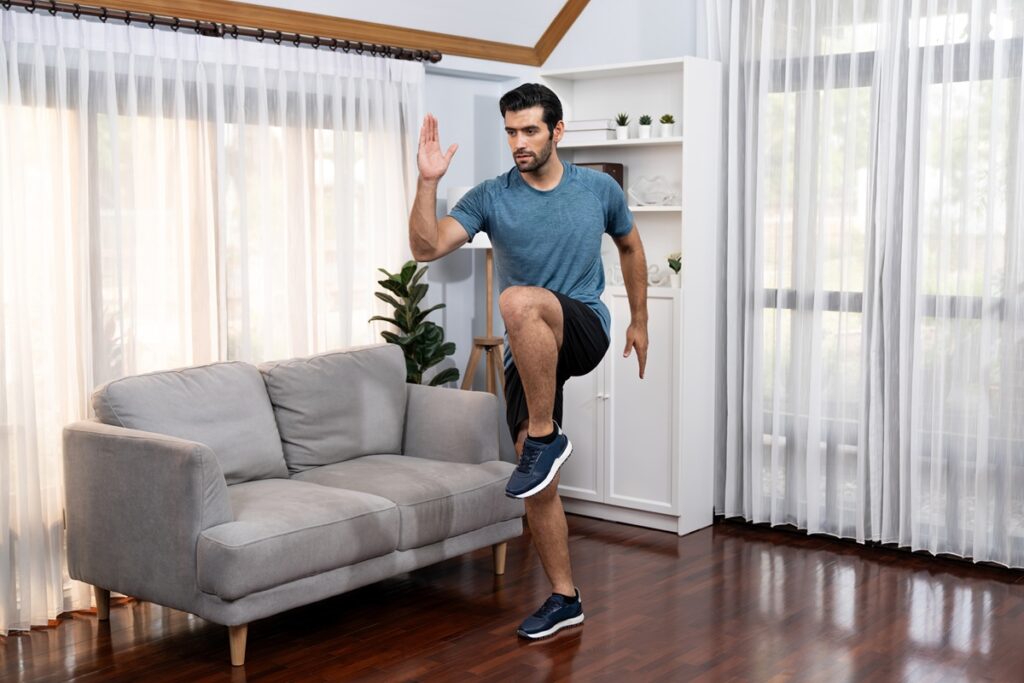
Getting back to jumping without knee pain is very doable once you find the cause and rebuild the knee the right way. Knee pain with jumping is a common frustration for active adults, and the source can vary quite a bit from person to person. The good news is that a few shared principles help across almost all of them. Below are five safe steps to jumping without knee pain, plus what tends to cause it and how to land like an athlete again.
What Causes Knee Pain With Jumping?
Because the knee is a busy hub, jumping pain can come from several places. It might be the patellar tendon (patellar tendonitis) or the quad tendon, the outside of the knee along the IT band, a meniscus issue at the joint line, the inner knee from bursitis, or a kneecap that does not track well (patellofemoral pain). An exam pins down which one you are dealing with, and while each is treated a little differently, the same core principles get most people back to jumping without knee pain.
Underneath the specific diagnosis, the drivers are usually similar: the lower leg does not line up well through the hip, knee, and foot, the kneecap tracks poorly, and there is stiffness at the hips and ankles plus weakness in the hips, thighs, and glutes. When your hips and core are weak, your knee absorbs forces it was not meant to, which shows up the moment you take off or land.
5 Safe Steps to Jumping Without Knee Pain
This progression calms the pain first, then rebuilds the knee and your landing so jumping stops hurting. Move at a comfortable pace and back off anything that sharply increases your pain.
1. Identify Your Specific Limitations
Start with a movement assessment. Knowing whether your pain comes from a tendon, the kneecap, the IT band, or a mobility gap is what makes the rest of the plan effective instead of guesswork.
2. Calm the Pain
Next, take a short break from jumping so the irritation can settle and healing can begin. If pain lingers, hands-on therapy can speed up that early relief. This first phase makes the strengthening that follows far more comfortable.
3. Strengthen the Muscles That Protect the Knee
Often the hamstrings, calves, and glutes are not strong enough to help with jumping, so the quads overwork and tug on the kneecap and tendons. Building strength through the hips and posterior chain fixes that. It also protects the joint on landing: strong hips help control knee alignment, reducing the inward collapse (valgus) that overloads the knee. Go-to moves include bridge variations, quad sets, and calf raises, and for the tendon itself, progressive loading is the best-supported approach for jumper’s knee.
4. Restore Hip and Ankle Mobility
To jump and land well, you need to flex your hips and ankles to absorb force. If those are stiff, the knee takes the hit. Drills like tall-kneeling sit-backs, the 90/90 get-up, and half-kneeling ankle dorsiflexion restore that motion. You can find demonstrations in our video library.
5. Rebuild Your Jump With Good Technique
Finally, reintroduce jumping itself. Good technique means loading the hips and thighs on takeoff and landing softly to absorb force rather than slamming through the knee. Once your technique is solid, progressively increase the height you jump onto and down from, using a plyobox to train both directions. Rebuilding the skill of jumping, not just the strength, is what makes jumping without knee pain stick.
How Long Until I Can Jump Pain-Free Again?
It depends on the cause and how long it has been going on, but many people feel meaningful relief within a few weeks as pain calms and strength returns, with a full, confident return to jumping over one to three months. Tendons in particular respond to gradual, progressive loading, so patience and consistency beat rushing back. The goal is not just less pain today, but a knee that tolerates jumping for the long haul.
The Most Common Mistake
The biggest error we see is treating this as purely a knee problem. People rest, stretch the sore spot, and then jump right back into full training, only to flare again. Jumping without knee pain is rarely about the knee alone; it is about how the hip, knee, and ankle share load, and about the skill of taking off and landing. Skipping the strength and technique work and going straight back to hard jumping is the fastest way to end up back where you started. The second common mistake is doing too much too soon once the pain eases, before the tissues and technique are ready. A gradual, guided return is what makes jumping without knee pain last.
Frequently Asked Questions
Should I stop jumping completely if my knee hurts?
Usually just for a short while, not forever. A brief break lets the irritation calm, but the fix is rebuilding strength, mobility, and technique so you can return to jumping without knee pain, rather than avoiding it indefinitely.
Is it safe to push through knee pain when jumping?
No. Pushing through tends to make things worse and can turn a minor irritation into a stubborn one. Sharp or worsening pain is a signal to back off and get assessed before your next session.
What if my knee only hurts on landing?
Landing pain often points to a force-absorption problem, usually stiff ankles or hips or weak glutes, so the knee takes the load. Improving landing mechanics and hip strength is typically the key to jumping without knee pain in that case. Dialing in a soft, hip-loaded landing is often the single biggest step toward jumping without knee pain again.
Get Back to Jumping in Greenville, SC
When addressed with a specialized physical therapy program, jumping without knee pain is very achievable. Ignoring the pain and pushing through workouts, on the other hand, can lead to a further decline in your knee health. If you are worried about knee pain when you jump, the physical therapists at Movement Solutions in Greenville, SC would be glad to help.
If you are in knee pain but unsure what to do, call us at (864) 558-7346 and ask how we can help.
Medically reviewed by Dr. Tim Varghese, PT, DPT · Last updated August 28, 2026

Dr. Tim Varghese, PT, DPT
Dr. Tim Varghese, PT, DPT, is the founder of Movement Solutions Physical Therapy in Greenville, SC. He earned his Doctor of Physical Therapy from the Medical College of Georgia and is a Board-Certified Orthopedic Clinical…
More about Dr. Tim →