
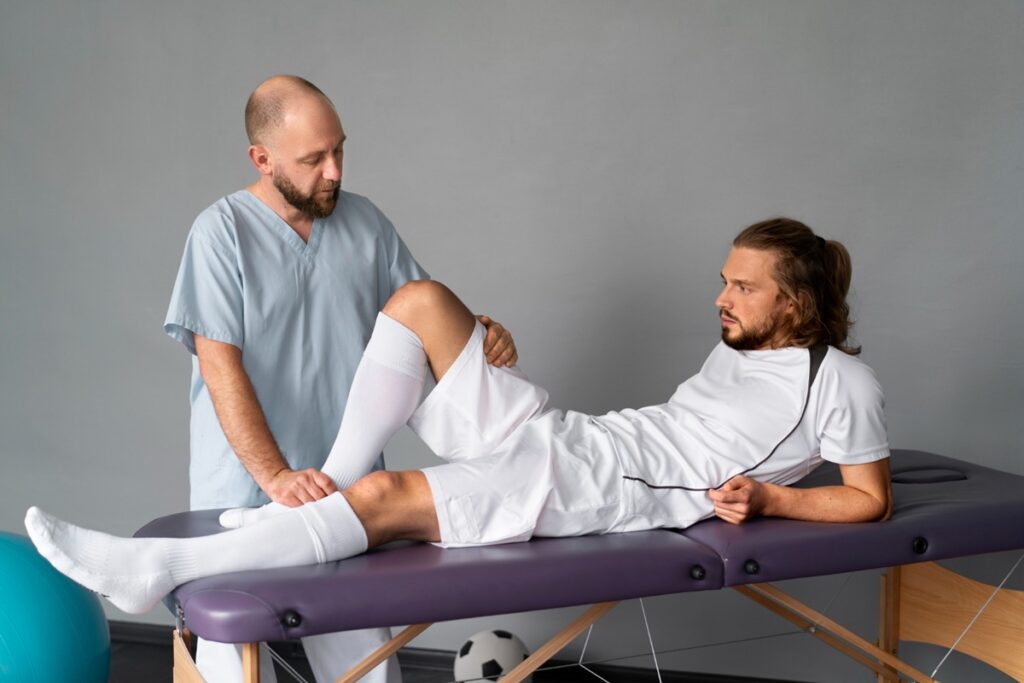
Arthroscopic knee surgery, the “knee scope,” is one of the most common orthopedic procedures, often done to address a meniscus or clean up the joint. Here is the part that decides how you do afterward: your knee arthroscopy recovery, not the surgery itself, is what determines whether you get back to the activities you love without the same problem returning. The scope can address a mechanical finding, but it does not fix why the pain developed in the first place, and that is exactly where smart rehab comes in.
Knee arthroscopy recovery works through four steps. Timing varies (a simple clean-up can feel better in weeks; a repair needs a longer, staged plan):
| Step | Focus |
|---|---|
| 1. Calm it down | Settle pain and swelling |
| 2. Restore motion | Regain full bend and straighten |
| 3. Fix the root cause | Address why the knee got irritated in the first place |
| 4. Build strength | Rebuild real, lasting strength |
Surgery Isn’t the Whole Story
It is worth knowing that arthroscopy is increasingly debated for wear-and-tear knees. A large systematic review found that arthroscopic surgery for degenerative knee problems provides only a small, often temporary benefit. That is not a reason for regret if you have already had the procedure. It is the reason your knee arthroscopy recovery matters so much: the operation may have smoothed a structure, but it left the underlying mobility, stability, and strength limitations untouched.
Those limitations are usually the real story. We commonly find weakness in the quad, hamstring, and calf, stiffness at the hip, and a lack of control at the core and buttock muscles. Pair that with a stiff big toe or weak foot muscles, and your movement mechanics suffer, which is what makes activities like running, stairs, squats, and lunges hurt. The only way to know which of these factors led to surgery, and to keep them from causing a repeat, is a complete assessment. That assessment is the foundation of a knee arthroscopy recovery that actually holds.
Step 1: Calm It Down
The first phase is to settle pain and swelling. Hands-on therapy helps here, easing discomfort and reducing swelling so the joint can start to move freely again. Gentle, early motion within the surgeon’s guidelines keeps the knee from getting stiff while tissues heal. This calm-down phase is the opening move of knee arthroscopy recovery, not the finish line, but it sets up everything that follows by giving the joint a quieter environment to rebuild in.
Step 2: Restore Motion
Next, restore the knee’s ability to fully bend and straighten. A knee that cannot reach full extension loads poorly with every step, so we use hands-on techniques and targeted drills to normalize motion. Regaining that clean bend-and-extend is a quiet but decisive part of knee arthroscopy recovery, because strength built on a stiff, poorly moving joint tends not to last. As motion returns, the knee starts to feel like yours again, and that is the cue to dig into why surgery was needed in the first place.
Step 3: Fix the Root Cause
Here is the step that separates a lasting result from a repeat trip to the surgeon. Once motion normalizes, we perform a full-body movement assessment and address each region that is holding the knee back. If poor mobility shows up at the hip or ankle, we use drills to unlock those stiff joints and muscles. If the core or buttock muscles are not firing, we teach activation exercises so they engage properly and stop dumping load onto the knee. Sorting out these root-cause limitations is the heart of knee arthroscopy recovery, and it is precisely what surgery alone cannot deliver.
Step 4: Build Strength
The most durable part of knee arthroscopy recovery is rebuilding real strength. Once the right muscles engage, we develop core and lower-body strength and teach you to squat, lunge, and hinge without pain. Done with good technique and progressed to match where the joint is in healing, these movements are excellent for developing strength and durability. This is strongly supported: a randomized trial found that supervised exercise therapy matched arthroscopic surgery for degenerative meniscus tears and produced greater thigh strength. In other words, the rehab is not a lesser consolation to the operation, it is a proven driver of the outcome, and our knee-strengthening guide builds this out.
When to Get It Checked First
Most post-scope recovery is smooth, but a few symptoms need prompt medical attention because this is a surgical context. Seek immediate care for calf pain, warmth, or swelling, or any shortness of breath, which can signal a blood clot. Contact your surgeon quickly for fever, spreading redness, or drainage from the incision, which can signal infection, and for a knee that locks, gives way, or was injured in a fall. Clearing these first is simply the safe way to begin knee arthroscopy recovery with confidence.
Frequently Asked Questions
How long does knee arthroscopy recovery take?
It varies with what was done. A simple clean-up can feel better in weeks, while a meniscus or ligament repair needs a longer, staged plan. What matters more than the calendar is that your knee arthroscopy recovery progresses through motion, then control, then strength, rather than rushing back to full activity.
Do I really need physical therapy after a knee scope?
For most people, yes. The surgery addresses a structure, not the mobility and strength limitations that led to the problem. Skipping rehab is the most common reason symptoms return, which is why a guided knee arthroscopy recovery is worth the effort.
Will the same problem come back?
It can if the root cause is never addressed. Repetitive activity with poor mechanics is what drives a repeat injury. A thorough assessment plus targeted strengthening is how a good knee arthroscopy recovery lowers that risk.
Should I have had the surgery at all?
If it is already done, that question is behind you, and your energy is best spent on rehab. If you are still weighing options for a degenerative meniscus, our post on a torn meniscus without surgery walks through the evidence for trying exercise first.
Get Back to Activity in Greenville, SC
Addressed with a thorough assessment and the right plan, getting back to exercise without repeat knee problems is very achievable, while grinding through poor mechanics tends to invite another injury. If you want a knee arthroscopy recovery that gets to the root cause, the physical therapists at Movement Solutions in Greenville, SC would be glad to help. Explore our knee pain resources to start.
We also offer a free 15-minute phone consultation to talk through your options. Call us at (864) 558-7346 and ask how we can help.
Medically reviewed by Dr. Tim Varghese, PT, DPT · Last updated September 25, 2026

Dr. Tim Varghese, PT, DPT
Dr. Tim Varghese, PT, DPT, is the founder of Movement Solutions Physical Therapy in Greenville, SC. He earned his Doctor of Physical Therapy from the Medical College of Georgia and is a Board-Certified Orthopedic Clinical…
More about Dr. Tim →