
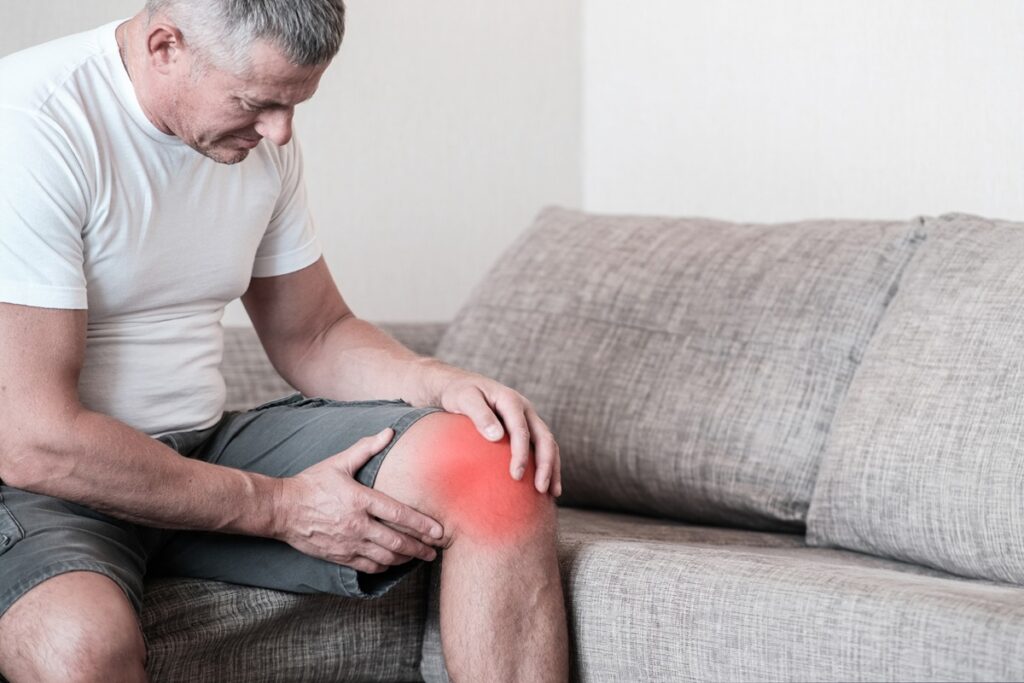
Almost everyone deals with knee pain at some point, and the causes of knee pain range from a mild, short-lived ache to a severe, lingering problem. Knee pain is common and getting more so: national data show the prevalence of knee pain has risen substantially over recent decades, even after accounting for age and weight. Conditions like knee arthritis, patellar tendinitis, pes anserine bursitis, meniscus tears, patellofemoral pain, and IT band syndrome get the headlines, but underneath most of them sits a short list of fixable limitations.
The Real Causes of Knee Pain Are Often Above and Below the Joint
Here is what we see over and over at Movement Solutions. A diagnosis names the irritated tissue, but it rarely explains why that tissue got irritated. When we assess active adults, the underlying causes of knee pain usually trace to five limitations, most of them at the ankle and hip rather than the knee itself:
- Stiffness of the ankle joint
- Stiffness of the hip muscles
- Weakness of the quads
- Weakness of the posterior chain (glutes and hamstrings)
- Weakness of the hip abductors and rotators
Adequate mobility at the calf and ankle is essential for normal movement. When that mobility is missing, the knee tends to cave inward as you walk, and it shows up even more during squatting, stepping, lunging, and jumping. Exercising with those imbalances loads sensitive structures like the kneecap, the quad and patellar tendons, and the meniscus, which is how the everyday causes of knee pain quietly turn into a named condition. The only way to know which apply to you is a thorough movement assessment.
Step 1: Calm It Down
The first step we often take in easing pain and restoring motion is hands-on manual therapy, which might include dry needling, soft-tissue work, joint mobilization, or manipulation. This settles the irritation and buys a window to move more freely. It is worth being honest, though: passive treatment alone will not deliver lasting gains, and addressing the causes of knee pain takes more than a good session on the table. Hands-on care is the opening move, not the cure.
Step 2: Build Lasting Mobility
Stiffness and tension are usually driven by weakness in the stiff muscle itself and in the muscle groups above and below it. Moreover, the body has to actively use a new range of motion for those gains to stick. That is why, to build lasting mobility, we activate and strengthen the muscle groups that were not doing their job, using specific drills that target those weak regions. Because so many causes of knee pain start at the ankle and hip, improving ankle mobility and hip mobility is often the fastest way to take twisting stress off the joint.
Step 3: Build End-Range Knee Stability
Once mobility is reinforced, the next job is stability. Knee stability comes from developing end-range strength in the quads, hamstrings, and calves, because the muscles around the knee are often weakest right where they need to control full bending and straightening. Targeting that end-range strength makes the knee feel far more comfortable and secure under load, and it removes one of the sneakier causes of knee pain in active adults. If you want the deeper logic on why range without control is not enough, our post on mobility versus stability explains it, and our knee-strengthening guide builds this out.
Step 4: Move Well Under Load
Here is the honest test. If you have good mobility and stability in static positions but the knee still hurts when you move or exercise, the plan is not finished. Strengthening the right areas matters: a systematic review found that adding hip and proximal muscle rehabilitation is effective for patellofemoral pain, one of the most common knee complaints.
So we coach you to move well both with and without resistance, in patterns that mimic your actual activities and sports. Grooving those patterns under gradually increasing load is what turns the causes of knee pain from a recurring problem into a resolved one, and it is the step people most often skip. If running is your thing, our guide to knee pain when running applies these same principles.
When to Get It Checked First
Most knee pain is safe to work on, but a few situations need prompt care. See a provider quickly if your knee locks, gives way, or cannot bear weight, or if it swells significantly and suddenly, which can signal an internal injury. Treat a hot, red, swollen, and feverish knee as urgent, since it can indicate a joint infection. And seek care for calf pain, warmth, or swelling below the knee, which can signal a blood clot. Ruling these out is simply the safe first step before working on the everyday causes of knee pain.
Frequently Asked Questions
What are the most common causes of knee pain?
In active adults, the usual causes of knee pain are stiff ankles and hips plus weakness in the quads, glutes, hamstrings, and hip stabilizers. Those limitations overload tissues like the kneecap, patellar tendon, and meniscus, which is what eventually earns a name like tendinitis or patellofemoral pain.
Is my knee pain coming from my knee or somewhere else?
Often somewhere else. The knee sits between the ankle and hip, so stiffness or weakness above and below frequently shows up as knee pain. That is why a whole-leg assessment usually finds the real causes of knee pain faster than focusing on the joint alone.
Do I need an MRI?
Usually not first. Imaging often reveals age-related changes that are common even in pain-free knees, so it does not always pinpoint the driver. A hands-on movement assessment is typically more useful for identifying the causes of knee pain that actually apply to you.
Can I keep exercising with knee pain?
Often yes, with modifications. The goal is to reduce what provokes the pain while you rebuild ankle and hip mobility plus leg strength, rather than stopping entirely. A good plan keeps you active while it resolves the causes of knee pain underneath.
Feel Better in Greenville, SC
Addressed with a thorough assessment and the right plan, resolving the common causes of knee pain is very achievable, while pushing through poor mechanics can turn a minor ache into a more serious condition. If you have knee pain when walking, squatting, running, hiking, or cycling, the physical therapists at Movement Solutions in Greenville, SC would be glad to help. Explore our knee pain resources to start.
Prefer to ask questions first? We also offer a free 15-minute phone consultation to talk through your options. Call us at (864) 558-7346 and ask how we can help.
Medically reviewed by Dr. Tim Varghese, PT, DPT · Last updated August 26, 2026

Dr. Tim Varghese, PT, DPT
Dr. Tim Varghese, PT, DPT, is the founder of Movement Solutions Physical Therapy in Greenville, SC. He earned his Doctor of Physical Therapy from the Medical College of Georgia and is a Board-Certified Orthopedic Clinical…
More about Dr. Tim →